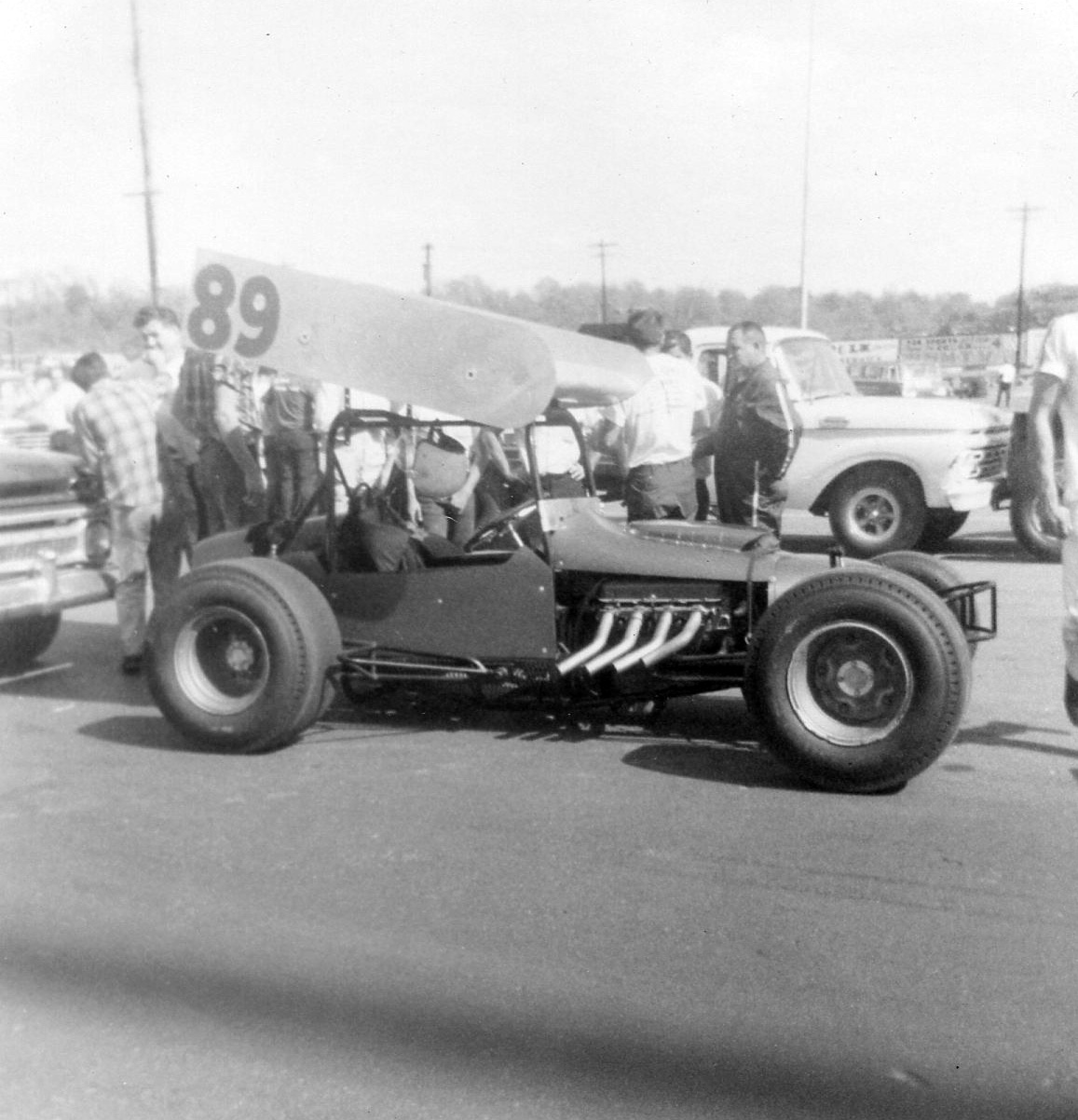
The track management in the early 60s was always willing to try new things. They added a support division
(first Hobby cars, then Cadets), Figure-8 racing, knockout races, the Joie Chitwood Thrill show, and a Powder Puff division
(although that had been tried at the Legion Bowl).
In 1964 they tried another experiment. Open Competition races. And the term is pretty much the rule book. And thet led to some of the most diverse fields of race cars in the history of the Fairgrounds.
The first race was run October 18, 1964. It was two weeks after the regular season was finished, so there was no threat of having your car demolished and being eliminated from points contention.
And sure enough, cars came out of the woodwork. Quite a few of the Modified Specials were still around, having been the main division at Highland Rim in 1964. Sprint cars showed up from Ohio and Indiana. Super Modifieds or "Skeeters" flocked in from Memphis. Although they knew they were at a disadvantage, the local guys who switched over to the Late Model Modifieds made up a part of the entry. The race paid $1,000 to win. Second place in the Grand National race that summer paid $1,000, so that was big money for the local drivers.
One of the stories that enticed the local fans was a combination of two of the strongest teams in Nashville racing. Bill Dyer owned the car Jimmy Griggs drove to the 1962 track championship and in 1963 Dyer had a fleet of three of the sharpest looking Modifieds to grace any racetrack. Charlie Binkley had moved up from the Hobby division to the Late Model Modifieds for 1964 and won the most races, taking home 6 victories. The two joined together for the 300-lap race, with Dyer putting Binkley behind the wheel of the #707 coupe. But there was one more twist - they decided to run a 75 gallon fuel tank so they could run the entire race without making a pit stop.
Thirty-nine cars took a qualifying lap and thirty cars took the green flag. Bobby Allison started from the pole with a fast lap of 20.11 seconds, breaking the track record of 20.50 set by his brother Donnie in qualifying for the 1963 Southern 300.
Another local favorite Jimmy Griggs was the first car out. Wrecks were frequent. A total of 91 of the 300 laps were run under the caution flag.
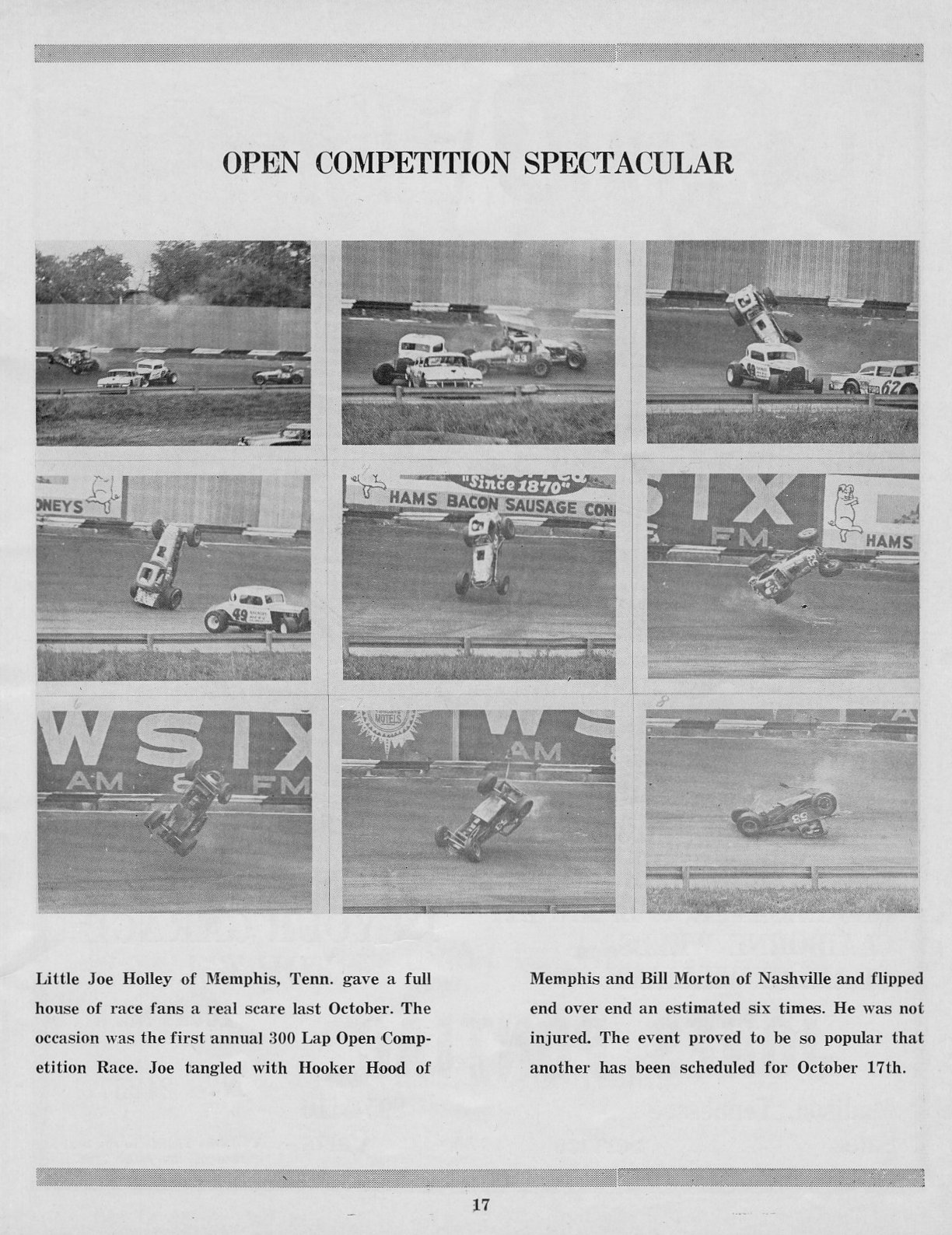
One of the accidents involved a nasty-looking flip by Joe Holley. A photo sequence of the crash appeared in the 1965 Souvenir Program:
In 1964 they tried another experiment. Open Competition races. And the term is pretty much the rule book. And thet led to some of the most diverse fields of race cars in the history of the Fairgrounds.
The first race was run October 18, 1964. It was two weeks after the regular season was finished, so there was no threat of having your car demolished and being eliminated from points contention.
And sure enough, cars came out of the woodwork. Quite a few of the Modified Specials were still around, having been the main division at Highland Rim in 1964. Sprint cars showed up from Ohio and Indiana. Super Modifieds or "Skeeters" flocked in from Memphis. Although they knew they were at a disadvantage, the local guys who switched over to the Late Model Modifieds made up a part of the entry. The race paid $1,000 to win. Second place in the Grand National race that summer paid $1,000, so that was big money for the local drivers.
One of the stories that enticed the local fans was a combination of two of the strongest teams in Nashville racing. Bill Dyer owned the car Jimmy Griggs drove to the 1962 track championship and in 1963 Dyer had a fleet of three of the sharpest looking Modifieds to grace any racetrack. Charlie Binkley had moved up from the Hobby division to the Late Model Modifieds for 1964 and won the most races, taking home 6 victories. The two joined together for the 300-lap race, with Dyer putting Binkley behind the wheel of the #707 coupe. But there was one more twist - they decided to run a 75 gallon fuel tank so they could run the entire race without making a pit stop.
Thirty-nine cars took a qualifying lap and thirty cars took the green flag. Bobby Allison started from the pole with a fast lap of 20.11 seconds, breaking the track record of 20.50 set by his brother Donnie in qualifying for the 1963 Southern 300.
Another local favorite Jimmy Griggs was the first car out. Wrecks were frequent. A total of 91 of the 300 laps were run under the caution flag.
One of the accidents involved a nasty-looking flip by Joe Holley. A photo sequence of the crash appeared in the 1965 Souvenir Program:
The plan of Dyer and Binkley worked to perfection. Binkley won the race by more than
a lap over Indianapolis 500 driver Carl Williams in a sprint car. The crowd of 7,500 liked what they saw.

The winning crew. L-R: Ken Gupton, Roy Binkley, Charlie Binkley, Ray Binkley, and Bill
Dyer
Three Races were scheduled for the 1965 season. Two 100-lappers during the season
and the final race was lengthed to a 400-lap grind to close out the season. Because of the grandstand fire, the final race was
canceled. Ellis Palasini came up from Memphis and won both of the 100-lap races with Griggs
finishing second in the first one and another Memphis driver, Armon Holley, was the runner-up in the
second race.

Coming to the green flag. You can see winged cars, full-bodied cars, and coupes
scattered through the field.

The field lines up for the start

Ellis Palasini won both 100-lap races in 1965

Charlie Binkley hits the wall in his Late Model while a coupe spins
and a sprint car slides down the banking just in front of Walter Wallace
The same schedule was used for the 1966 season. Two 100-lappers
and a 400-lap race two weeks after the Southern 300. Palasini couldn't make the trip,
but his car owner brought the car. He put Griggs in the car and not only did he win
the two 100-lap races, but won the October race by 11 laps over second place finisher Dick Gaines.

Jimmy Griggs receives the trophy after a 100-lap Open Competition race from Sally
Harrison and flagman Forrest Prince

Griggs stands beside his ride before the October 400-lap event
Two major accidents marred the 1966 400-lap race. A multi-car accident
in turns one and two early in the race involved three of the winged sprint cars and eliminated
local racer Bud Fox.

Jack Marlin (#1), Dick Gaines (#70), and an unidentified car crash in
turn one. Walter Wallace slips by in the #43

Charles Stofel squeezes by on the inside in his 59 Plynouth

Bud Fox piles in to the scene in his #22 while Bobby Walker goes low and
L.J. Hampton goes high in the 56
One of the most violent crashes in Speedway history occurred on lap
28. Gene Glover spun his Super Modified coming off turn two. Marty Robbins squeezed by on
the inside, but Ben Pruitt, driving Bill Dyer's Late Model Chevy #707, hit Glover a ton.
The entire accident was captured on film in an award-winning sequence by J.T. Phillips.

Glover spins and looks for oncoming traffic

Glover continues his spin, still untouched

Marty Robbins gets by on the inside

Ben Pruitt slams into Glover

The gas tank is over Pruitt's hood to the right of the wing on Glover's car

The cars continue sliding down the track as Bob Hunley goes high

Both cars come to a stop under the scoreboard

Coo Coo Marlin and safety workers attend to Glover
A note on the final photo. That's Coo Coo Marlin in the black on the
left side of the car. he was the first person to Glover's aid. In a strange twist of fate,
35 years later Glover's son Tony would be the crew chief on Marlin's son Sterling's Winston
Cup stock car. Glover nor Pruitt were seriously injured in the accident. After avoiding the
accident, Marty Robbins continued on to a 4th place finish.
The final Open Competition race was held on October 15, 1967. It was called the "International 300", shortened from the 1966 version by 100 laps. One of the most radical cars ever seen at Nashville was brought in from West Tennessee for Walter Wallace to drive. It was a low-slung rear-engine car with a cage and a huge wing. Wallace adapted quickly to the car and qualified on the pole at the all-time track record for the half-mile track at 19.14 seconds, or an average speed of 94.04 miles per hour. The following photos (except for the color shot) all come from Walter Wallace's collection and were taken by Fred Marchman.
The final Open Competition race was held on October 15, 1967. It was called the "International 300", shortened from the 1966 version by 100 laps. One of the most radical cars ever seen at Nashville was brought in from West Tennessee for Walter Wallace to drive. It was a low-slung rear-engine car with a cage and a huge wing. Wallace adapted quickly to the car and qualified on the pole at the all-time track record for the half-mile track at 19.14 seconds, or an average speed of 94.04 miles per hour. The following photos (except for the color shot) all come from Walter Wallace's collection and were taken by Fred Marchman.


Staring alongside Wallace was Jimmy Griggs driving the same car in
which he swept the 1966 races. Wallace told me he sat so low in his car that on the pace
lap he looked to his left and all he could see was the right front hub on Griggs' car.

Wallace and Griggs line up at the front of the field
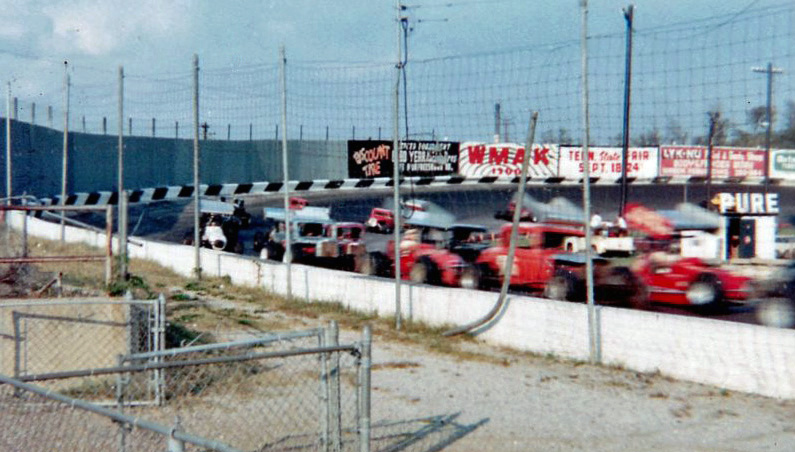
Wayne Vick snapped this photo of the field coming off turn 4
Wallace led the first 7 laps before Griggs took the lead. Wallace's
day came to an end on lap 40 when he was caught up in a wreck on the backstraight with
Don Nordhorn.

Wallace leads Griggs early in the race

End of the day for the rear-engined rocket
Griggs held the lead to lap 115 when his sway bar broke and forced him
to the pits. Nolan Johncock from Hastings, MI, cousin of future Indy winner Gordon Johncock,
took the lead and won by two laps over Herman Wise of Atlanta.
With the cars getting so exotic and more out of towners coming in and knocking the local guys out of the field (only 9 locals were in the '67 race) and the crowd dropped off to 5,500 for the '67 race, the Open Competition races were removed from the schedule after the 1967 season.
But in the seven races run over 4 seasons, race fans saw some incredibly fast racing, some scary crashes, and a lot of innovation. Another chapter in racing at the Fairgrounds had come to a close.
With the cars getting so exotic and more out of towners coming in and knocking the local guys out of the field (only 9 locals were in the '67 race) and the crowd dropped off to 5,500 for the '67 race, the Open Competition races were removed from the schedule after the 1967 season.
But in the seven races run over 4 seasons, race fans saw some incredibly fast racing, some scary crashes, and a lot of innovation. Another chapter in racing at the Fairgrounds had come to a close.
Here is almost 7 minutes of 16mm film from the 1966 400-lap Open Competition race. There is
no sound with this video.
Years after I originally wrote this in 2012 another set of photos from the 1966 and 1967
season-ending races were discovered. Click on the photo to take you to another page with more photos from those two races: