Although the local weekly races at the Fairgrounds have always been run with “stock cars”
and the special events that stand out in people’s memory are of Cup, Busch (now O'Reilly Auto Parts Series), ASA series, and the All-American
400, there have always been other “special events” peppered throughout the years at the Fairgrounds. It should
come as no surprise to those who know me that I’d get around to talking about open wheel racing.
When you hear the names A.J. Foyt, Parnelli Jones, Jim Hurtubise, Eddie Sachs, and Don Branson you probably associate them with the Indianapolis 500. They all either won or at least started on the front row at Indy.
But all those stars of Indianapolis and more raced at the Fairgrounds.
When the first races were held at the Fairgrounds in 1904 there were no distinctions like "stock cars" or "Indy cars". They were just cars. More accurately, automobiles. Starting in 1918, except for the 1937 race, the races during the Fair were sanctioned by the International Motor Contest Association, or IMCA. The IMCA series was used as a training ground or springboard to the Indy cars, much like the O'Reilly Auto Parts Series today in Nascar. IMCA even put on a couple of races in May in the early days.
What some referred to as “big cars”, similar to what competed in the Indianapolis 500, are what raced at the Fairgrounds during the State Fair. A couple of star drivers of the era competed in the 1937 race at the Fairgrounds when IMCA took a one year hiatus and the AAA sanctioned the race. Duke Nalon, who was most famous for driving the famous Novi in the 500, and Ted Horn, who was a three-time National Champion driver both raced here in '37. The event was rain delayed a day and there are some stories still floating around about how the drivers passed the time during the delay with a card game on a boat on the Cumberland River. Nalon came back the next day to win the race.
When you hear the names A.J. Foyt, Parnelli Jones, Jim Hurtubise, Eddie Sachs, and Don Branson you probably associate them with the Indianapolis 500. They all either won or at least started on the front row at Indy.
But all those stars of Indianapolis and more raced at the Fairgrounds.
When the first races were held at the Fairgrounds in 1904 there were no distinctions like "stock cars" or "Indy cars". They were just cars. More accurately, automobiles. Starting in 1918, except for the 1937 race, the races during the Fair were sanctioned by the International Motor Contest Association, or IMCA. The IMCA series was used as a training ground or springboard to the Indy cars, much like the O'Reilly Auto Parts Series today in Nascar. IMCA even put on a couple of races in May in the early days.
What some referred to as “big cars”, similar to what competed in the Indianapolis 500, are what raced at the Fairgrounds during the State Fair. A couple of star drivers of the era competed in the 1937 race at the Fairgrounds when IMCA took a one year hiatus and the AAA sanctioned the race. Duke Nalon, who was most famous for driving the famous Novi in the 500, and Ted Horn, who was a three-time National Champion driver both raced here in '37. The event was rain delayed a day and there are some stories still floating around about how the drivers passed the time during the delay with a card game on a boat on the Cumberland River. Nalon came back the next day to win the race.
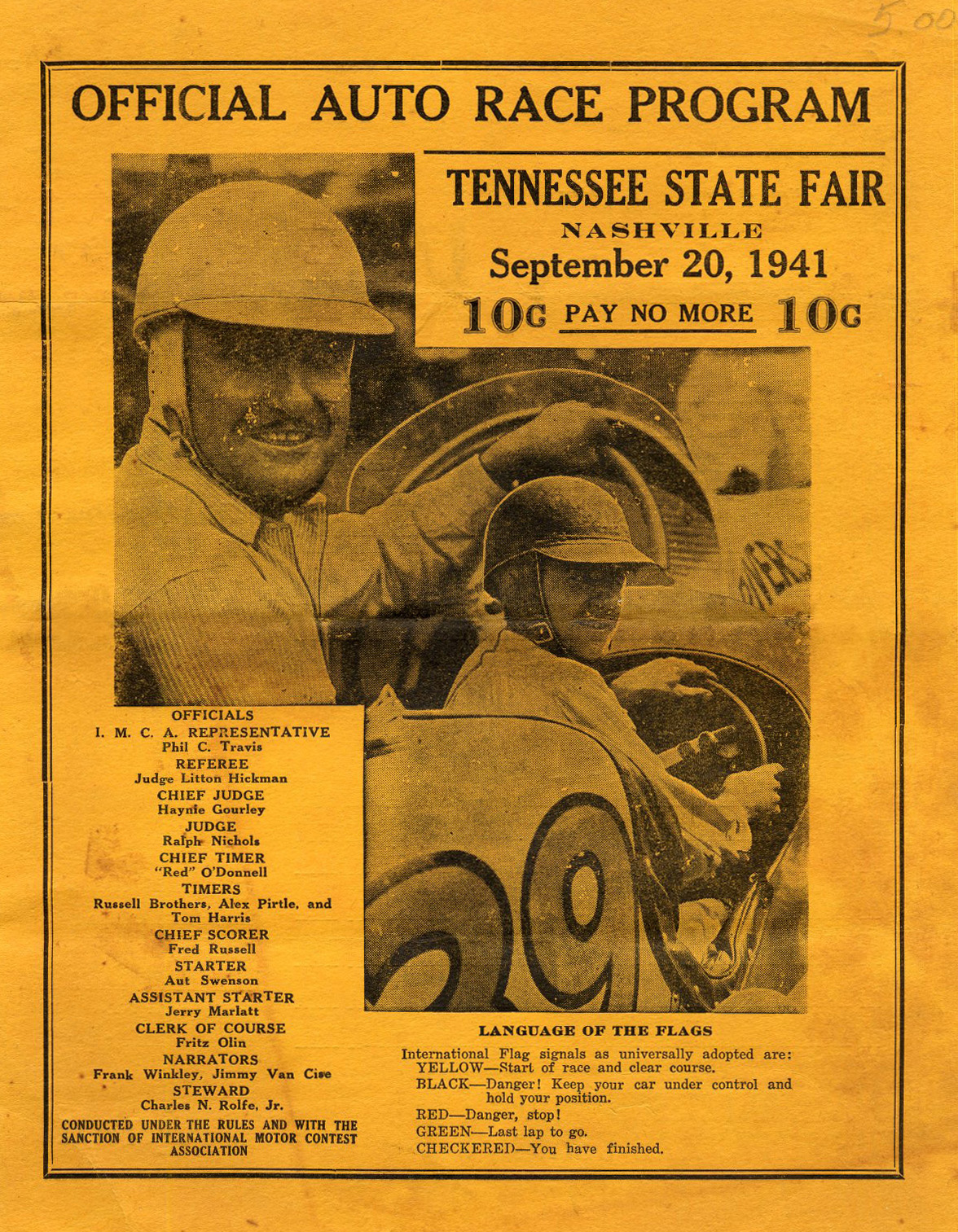
Click on the program to enlarge it.Notice the names of some of the officials - some very prominent
Nashvillians!
All auto racing was suspended during World War II. The nation was basically shut down because
everything was devoted to the war effort. As the war drew to a close, people were starved for entertainment.
When racing resumed in 1946, there was great interest in the race to be held during the Fair. Attendance records were set every day during the Fair. The races were to be held on the second Saturday of the Fair, or the next to last day of the Fair. Among the entries were favorite Emory Collins, Chuck Frame of Kansas, and 18 year old Bill Steeley of Danville, IL. Frame would be driving the “jinx car”, a car that had fatally injured two drivers earlier in the year and Steeley was said to be, “the youngest professional driver in the nation today.”
Another highlight to the day’s program would be an exhibition by Antonio Granatelli in his rocket-powered car. You might know him better as Andy Granatelli, the man who made STP a household name. In 1972 he also orchestrated the sponsorship by STP of Richard Petty.
When racing resumed in 1946, there was great interest in the race to be held during the Fair. Attendance records were set every day during the Fair. The races were to be held on the second Saturday of the Fair, or the next to last day of the Fair. Among the entries were favorite Emory Collins, Chuck Frame of Kansas, and 18 year old Bill Steeley of Danville, IL. Frame would be driving the “jinx car”, a car that had fatally injured two drivers earlier in the year and Steeley was said to be, “the youngest professional driver in the nation today.”
Another highlight to the day’s program would be an exhibition by Antonio Granatelli in his rocket-powered car. You might know him better as Andy Granatelli, the man who made STP a household name. In 1972 he also orchestrated the sponsorship by STP of Richard Petty.

Tennessean front page from 1946 showing the packed stands
Race day saw the largest crowd in Fairgrounds history. Keep in mind this was 1946 – that was
15 years before interstates were built in Nashville. The three downtown bridges (Jefferson, Woodland, and Shelby -
the Victory Memorial Bridge (Main Street) hadn't been built yet) were the only way for those on the east side of the river to get
to the Fairgrounds. Photos in the paper show traffic backed up two wide from the Fairgrounds down Fourth Avenue to
town and across the Shelby Street bridge. The Tennessean reported the attendance for Saturday’s races as 56,000.
Remember that the midway for the Fair was in the infield of the track and many people watched the races from the
infield (much like the Kentucky Derby at Churchill Downs). But the grandstands were filled to overflowing.
And the crowd wasn’t disappointed. Granatelli set a world’s record of over 108 miles-per-hour in his demonstration run. And the pre-race favorite Collins won the feature.
And the crowd wasn’t disappointed. Granatelli set a world’s record of over 108 miles-per-hour in his demonstration run. And the pre-race favorite Collins won the feature.
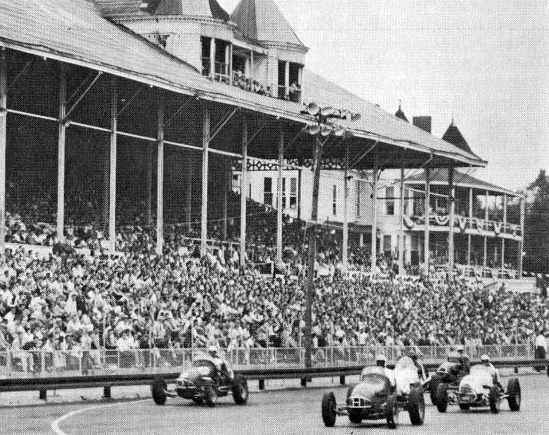
IMCA Sprint cars on the front straight in 1961.
The IMCA cars continued racing during the Fair through 1968. They even ran in 1965, 4 days
after the fire that destroyed the grandstands. The bleachers weren’t heavily damaged by the fire, so they were used
for spectators for the 1965 races. IMCA ran a total of 22 races after the paved track was built. A.J. Sheppard won
4 races to lead all drivers on the paved track.
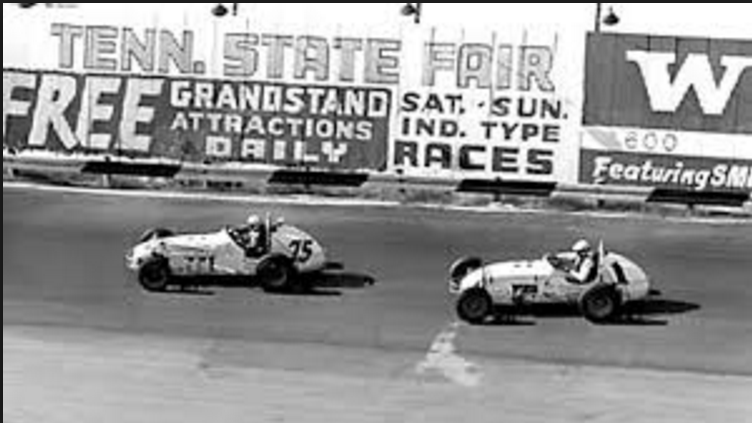
Dean Mast from Sugar Creek, OH, leads Johnny White in the 1963 IMCA race.
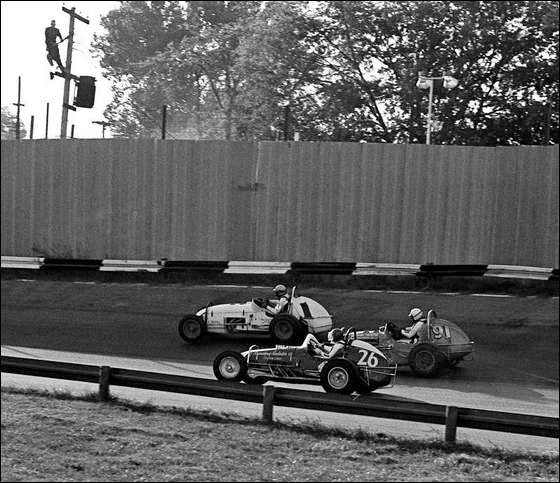
Johnny White (#1) leads off turn 4 in 1963. Notice the guy watching the race from the top of the light pole!
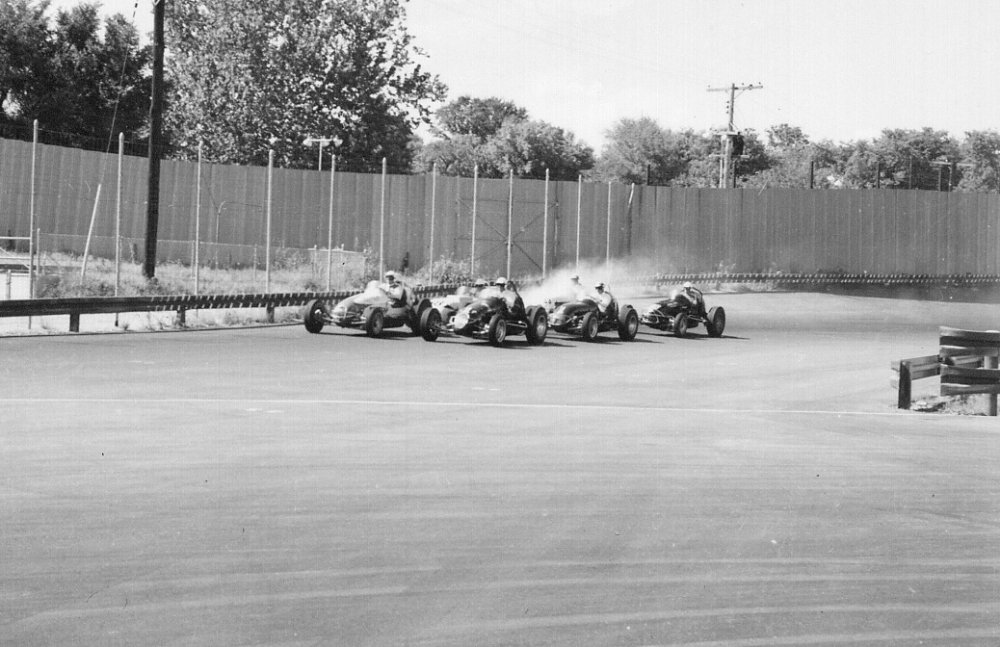
IMCA Sprint cars come smoking off turn 4 for a heat race
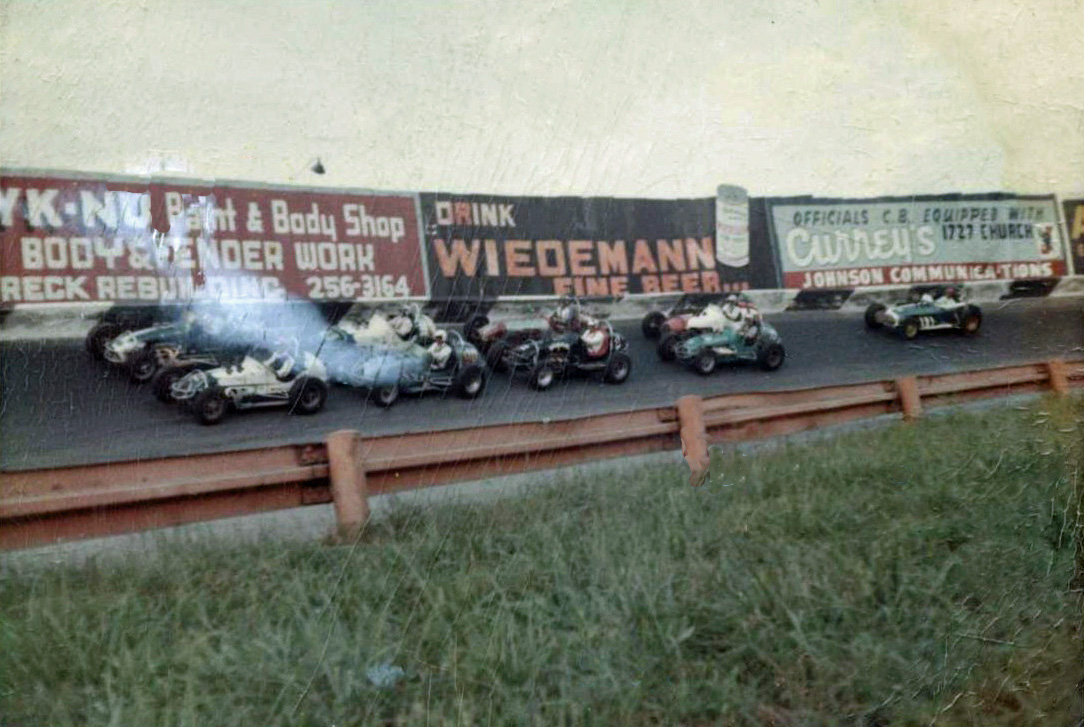
IMCA cars lining up for a heat race in 1966
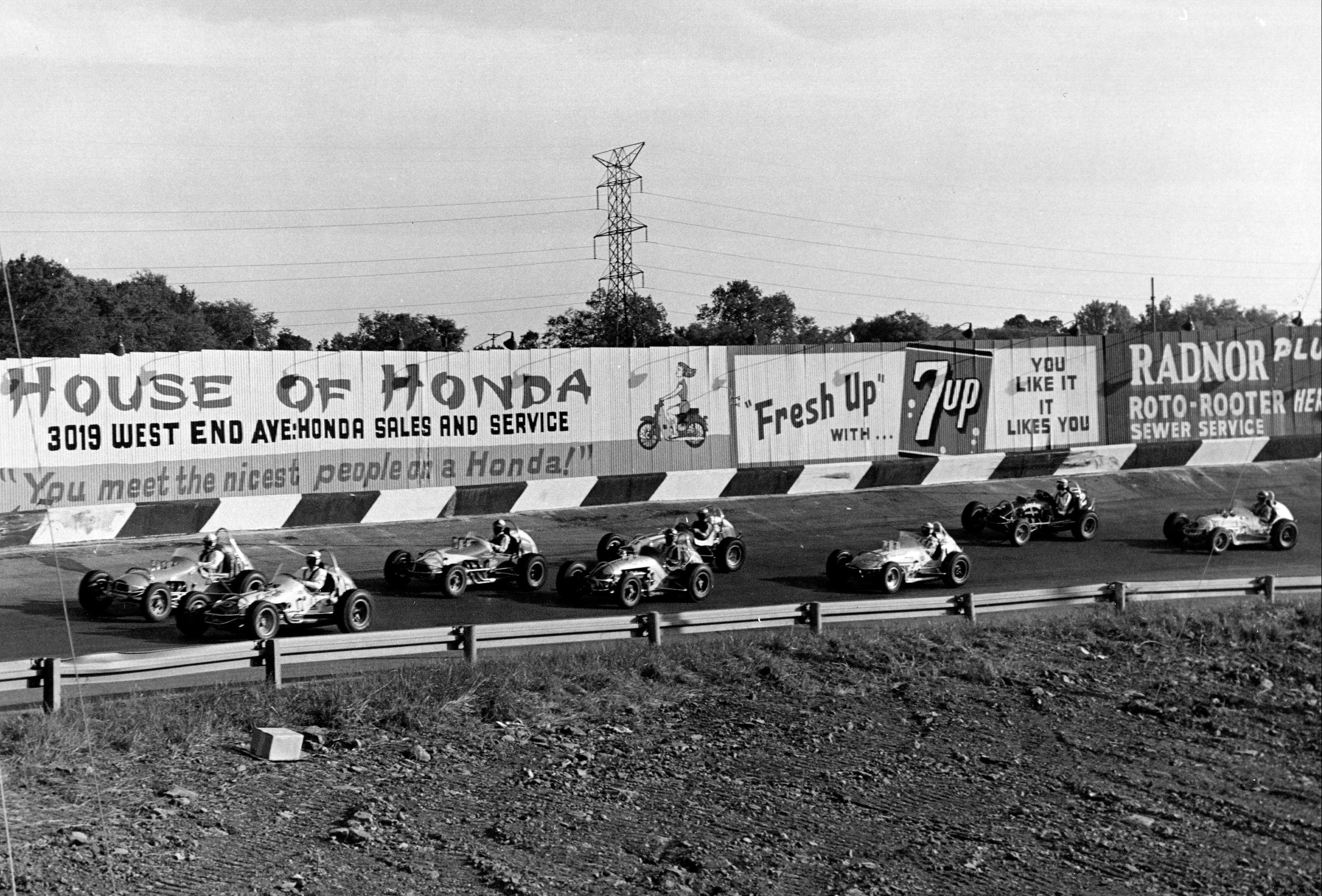
The IMCA Sprint cars line up on the pace lap in 1966
In July of 1959 the USAC Sprint cars ran a 30-lap feature on the half-mile track.
Jim McWithey turned a lap at 20.932 seconds to qualify on the pole. Future USAC
Sprint car champion Don Branson won the race with McWithey hanging on for second,
Leon Clum came home third, followed by Eddie Sachs and A.J. Foyt. Sachs would
qualify on the pole for the following two Indianapolis 500s. The next three photos
are from the USAC Sprint race:
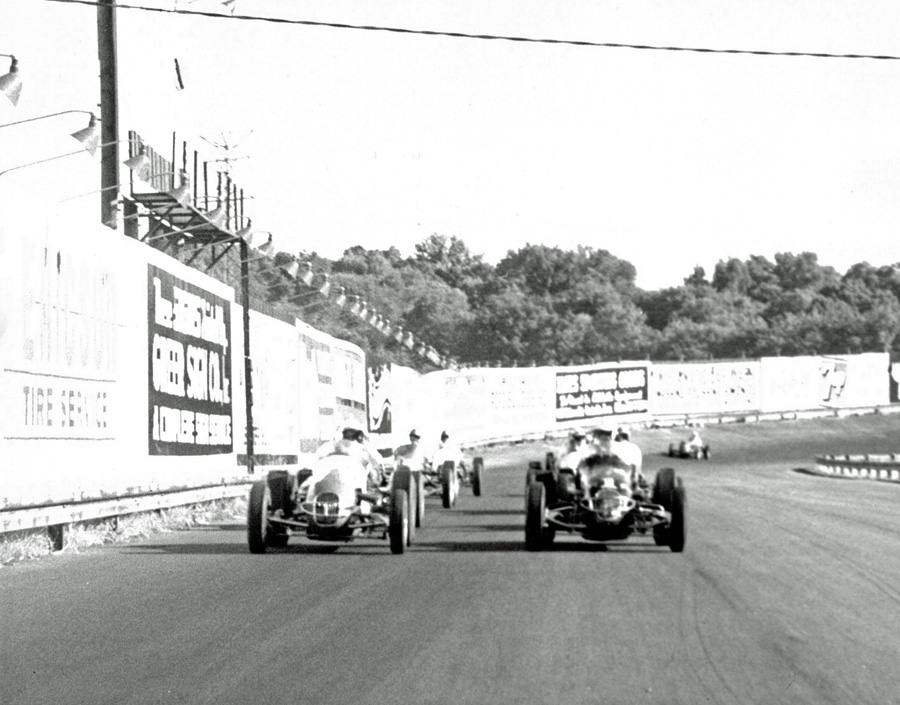
Jim McWithey and Don Branson lead the field on the pace lap
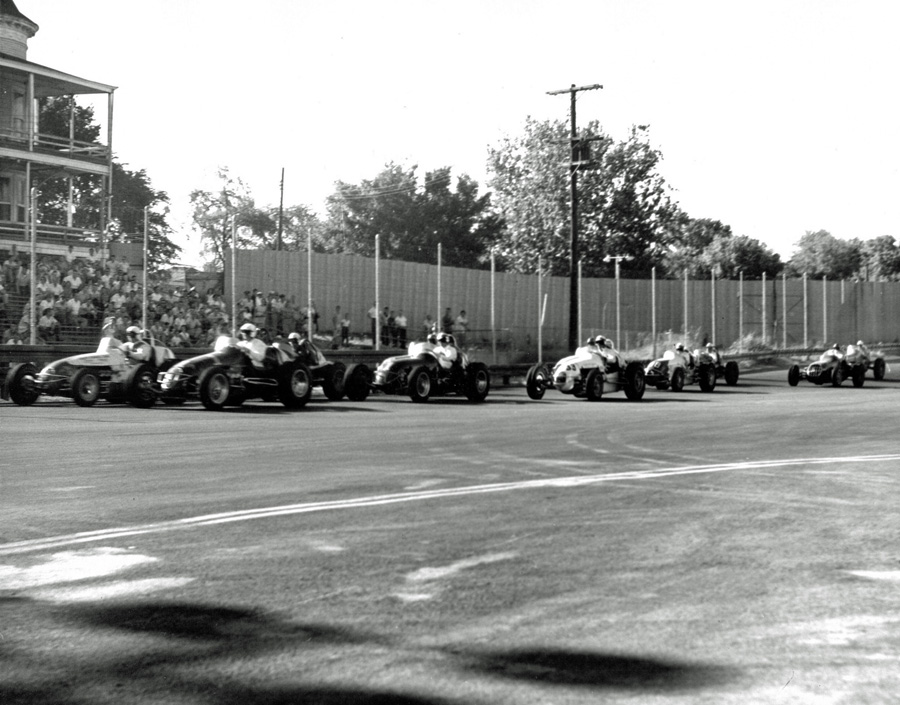
McWithey and Branson bring the field to the green
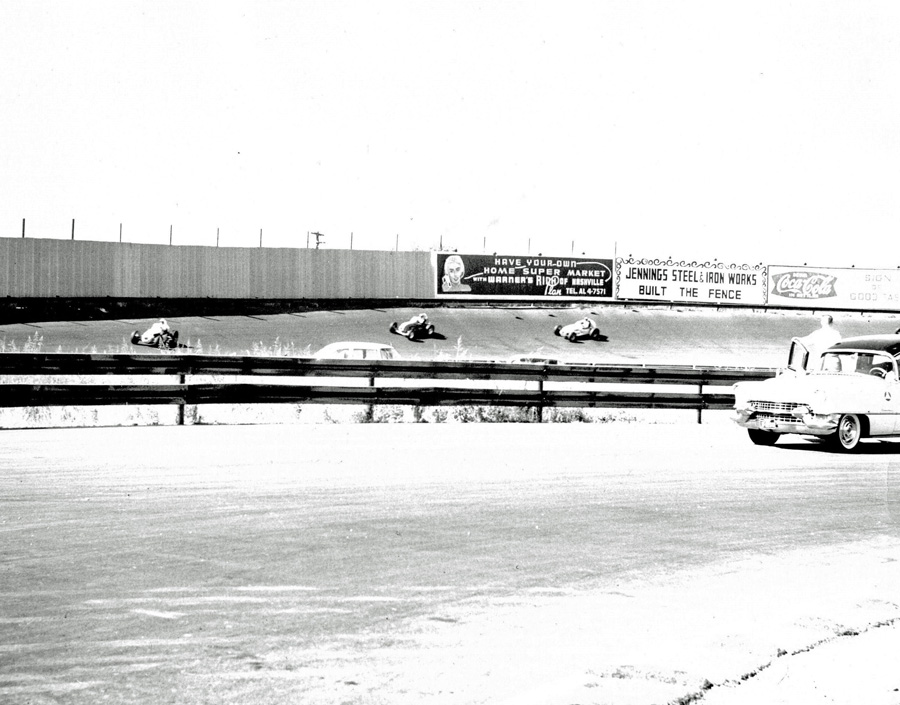
Three cars on the banking during the USAC Sprint race
The USAC Midget division competed on the quarter-mile track in 1960 and 1961.
Long-time Midget star Jimmy Davies won the race in 1960 and Dale Swain surprised
the regulars and won in 1961.
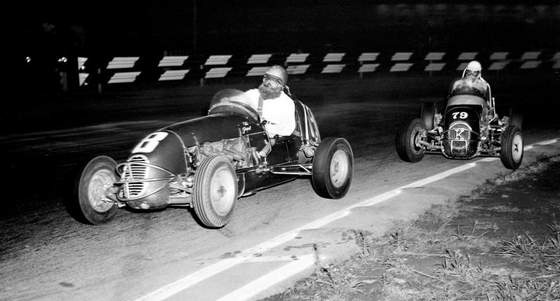
USAC Midgets compete on the quarter-mile in 1961
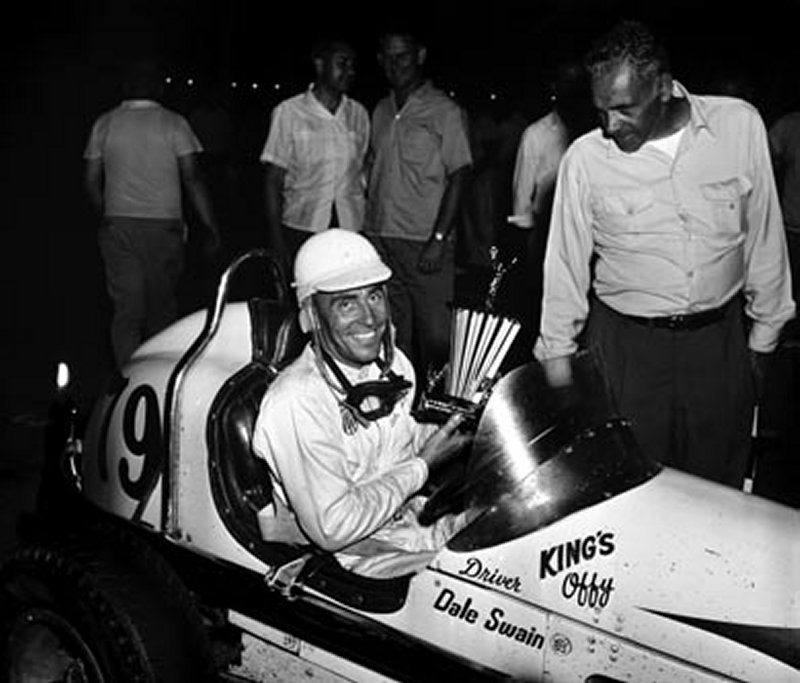
1961 USAC Midget winner Dale Swain
So as you see, open wheel cars have a deep history at the Fairgrounds. Then there
are the cars that raced in the Open Competition events in the mid-60s. But those
races are another story for another day.