There are lots of the wonderful old souvenir programs floating around.
Many of them are available to browse through on this site. Let's take a look at some of the
other items that have been used to promote the track through the years. You can click on
any item to see it enlarged.

These handy little pocket schedules were printed for quite a few years:
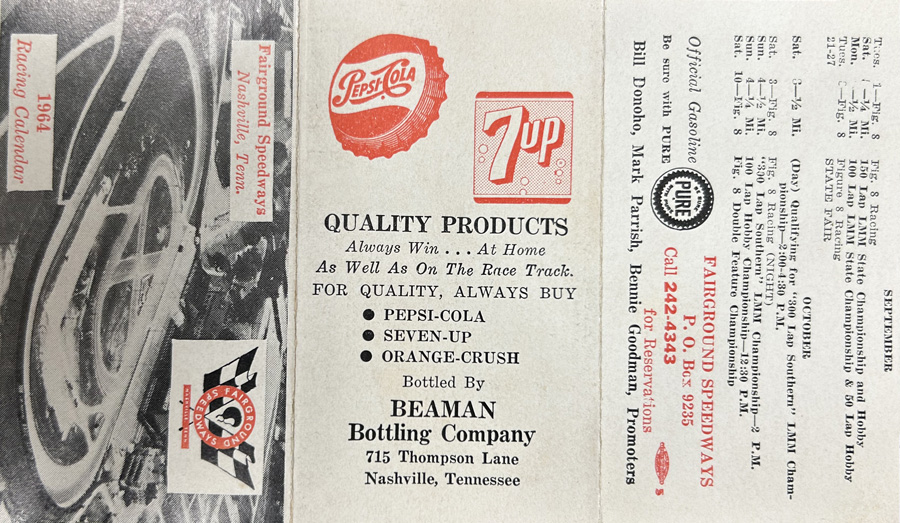
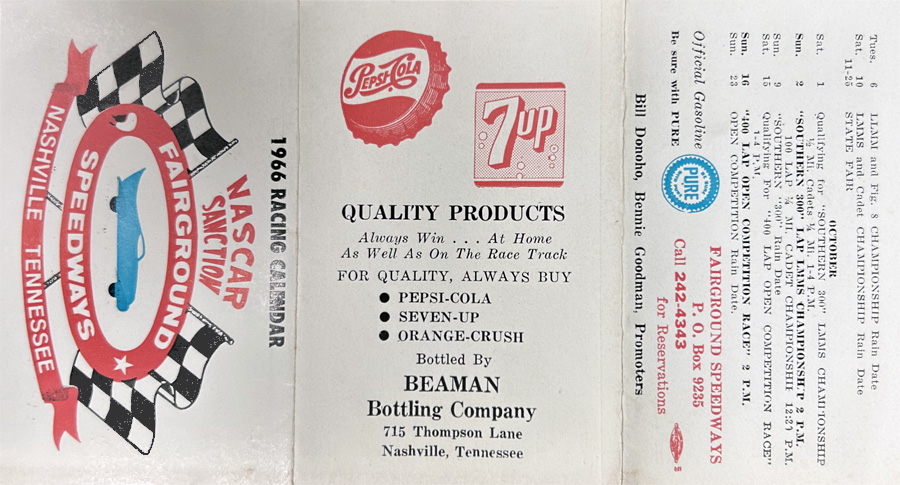


Another item I thought was cool was this dog tag. They did those two or
three years and they always had the defending track champion on them. I think I have one with
Darrell around here somewhere.

Then there were the yearly ticket brochures. Some of these had almost
as much information as the programs.
Here's the one for the first Nashville 420 held on the high banked track in 1970:
Here's the one for the first Nashville 420 held on the high banked track in 1970:


One from 1973. After the season, I wrote in the winners to each
race that was highlighted:


For the 1977 season:


Order tickets here for the 1978 Music City 420:


This one gets defending 420 winner Dale Earnhardt on the cover:


The order form for the last Spring 420 in 1984:


Can't believe this one is already 35 years old:


Here is a patch worn by officials and drivers in 1990:

Here are two entry blanks for the Grand National (Cup) 400 / 420
races, 10 years apart. Winner's share just a little more than doubled, but the
total purse took quite a jump:


This brochure is for the Mr. D's 200. The Mr. D's 200 was a Grand National
East race. The Grand National East division started in 1972, made up mostly of the short tracks
that were dropped from the main Grand National schedule when Winston demanded the schedule be
cut from fifty-plus races down to 30 races of 250 miles or longer. The fields were comprised
of both full-size Grand National (now Cup) cars and Grand American cars. This was the 5th
race in the division's history.
Bobby Allison won the race driving a Ford Mustang while Elmo Langley was 2nd in his Ford GN car. NASCAR was so impressed with the size of the crowd and the professionalism in which the track ran the event, Nashville was awarded a second Cup race the following year, and the Music City 420 was added to the 1973 schedule. That event stayed on the schedule until NASCAR took both Cup dates away in March of 1985.
One other thing about the race sponsor. For those of you not up to speed on your seafood restaurant history, the first Mr. D's seafood restaurant was opened in Donelson, TN, in 1969. Not long after they sponsored this race, they changed their name to Captain D's.
Bobby Allison won the race driving a Ford Mustang while Elmo Langley was 2nd in his Ford GN car. NASCAR was so impressed with the size of the crowd and the professionalism in which the track ran the event, Nashville was awarded a second Cup race the following year, and the Music City 420 was added to the 1973 schedule. That event stayed on the schedule until NASCAR took both Cup dates away in March of 1985.
One other thing about the race sponsor. For those of you not up to speed on your seafood restaurant history, the first Mr. D's seafood restaurant was opened in Donelson, TN, in 1969. Not long after they sponsored this race, they changed their name to Captain D's.

Another unique race from the 1972 season was the Tennessee 200
USAC stock car race. USAC stands for United States Auto Club. They were the sanctioning
body for the Indianapolis 500, but they also had a stock car division. They had competed
at Nashville in 1959 and 1960, and in the sixties on a national level, the series was
nearly an equal to NASCAR (which at the time was seen as more of a Southeastern regional
sport). In the fifties, sixties, and even into the 70s, many drivers who competed in the
Indianapolis 500 also competed in many of the USAC stock car races.
Although the brochure states AJ Foyt would be competing, he didn't make it to Nashville. But Indy stars Bobby Unser, Gordon Johncock, and Roger McCluskey were in the race along with the full-time USAC stock car stars.
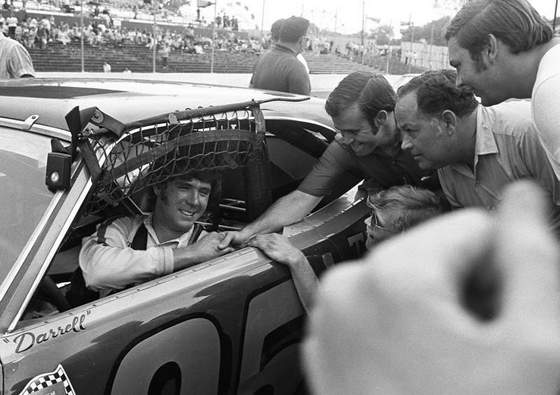
But unknown to the USAC stars, there was an unknown ringer in the field. In September of 1972 Darrell Waltrip had raced in a total of four Winston Cup races. But he had three full years of experience on the 35-degree banks at Nashville. The Tennessee 200 was like throwing Br'er Rabbit in the briar patch. Running the same Terminal Transport Mercury he was running in the Cup series, Waltrip qualified on the pole, led all 200 laps, and lapped the field in the process.
Bobby Unser once told me he was driving as hard as he had ever driven, so tired he was about to fall out of the seat, and looked up and, "Here came Waltrip lapping me like I was tied. And waved as he went by!"
Unser finished second, one lap down, while Johncock was third, 4 laps down.
The USAC guys couldn't believe this kid they had never heard of had beaten them so badly. So they decided to tear the car apart during the post race inspection. The car was found legal in every area, and the USAC guys left scratching their heads with their tail between their legs.
I firmly believe that race helped put Waltrip's name on the national racing radar as much as anything he had done to that point in his career.
Although the brochure states AJ Foyt would be competing, he didn't make it to Nashville. But Indy stars Bobby Unser, Gordon Johncock, and Roger McCluskey were in the race along with the full-time USAC stock car stars.
But unknown to the USAC stars, there was an unknown ringer in the field. In September of 1972 Darrell Waltrip had raced in a total of four Winston Cup races. But he had three full years of experience on the 35-degree banks at Nashville. The Tennessee 200 was like throwing Br'er Rabbit in the briar patch. Running the same Terminal Transport Mercury he was running in the Cup series, Waltrip qualified on the pole, led all 200 laps, and lapped the field in the process.
Bobby Unser once told me he was driving as hard as he had ever driven, so tired he was about to fall out of the seat, and looked up and, "Here came Waltrip lapping me like I was tied. And waved as he went by!"
Unser finished second, one lap down, while Johncock was third, 4 laps down.
The USAC guys couldn't believe this kid they had never heard of had beaten them so badly. So they decided to tear the car apart during the post race inspection. The car was found legal in every area, and the USAC guys left scratching their heads with their tail between their legs.
I firmly believe that race helped put Waltrip's name on the national racing radar as much as anything he had done to that point in his career.

Click on the photo below for a separate page of photos and results from
the 1972 Tennessee 200:
This is a press release dated June 15, 1977. You can click on it to
enlarge it and read it, but it describes a new 1 1/8-mile Super Speedway to be built at
what is now the Waldron Road exit off of I-24 near Lavergne.
When the current Nashville Superspeedway was announced in the late nineties, most of the old school racers in Nashville were skeptical to say the least. This 1977 announcement is only one of the reasons. Too many times through the years we had been told there was going to be a speedway built in the Nashville area. In June of 1968 it was announced that the track at the Fairgrounds would be the first 3/4-mile track built in the country, to be ready for the 1969 season. Hmm. I'd say that plan worked out pretty good for Richmond 20 years later.
I don't know if this is fact or urban legend, but the reason I've always heard this track was never built is because when construction started, they found the entire site was almost solid bedrock. The demolition costs would have put the project too far over the money available, so the project was scrapped.
When the current Nashville Superspeedway was announced in the late nineties, most of the old school racers in Nashville were skeptical to say the least. This 1977 announcement is only one of the reasons. Too many times through the years we had been told there was going to be a speedway built in the Nashville area. In June of 1968 it was announced that the track at the Fairgrounds would be the first 3/4-mile track built in the country, to be ready for the 1969 season. Hmm. I'd say that plan worked out pretty good for Richmond 20 years later.
I don't know if this is fact or urban legend, but the reason I've always heard this track was never built is because when construction started, they found the entire site was almost solid bedrock. The demolition costs would have put the project too far over the money available, so the project was scrapped.

The next item is a cool license plate the track produced for the 1976
Bicentennial season. You'd see LOTS of these on vehicles in the late 70s in the Middle Tennessee area:

These final items help show just how special the Nashville
Fairgrounds Speedway is in the racing world. How many tracks that run just Saturday
night races have had die-cast cars produced of cars that have raced there and have
a track car of its own? Not being a die-cast collector I don't know the answer,
but I'd venture to say few, if any other track:
